

Satellite Ground Station Market Sees Strong Innovation Momentum Led by Key Industry Players
Market witnessing steady adoption across gvt space agencies, commercial satellite operators, telecommunication service providers, emerging space-tech companies
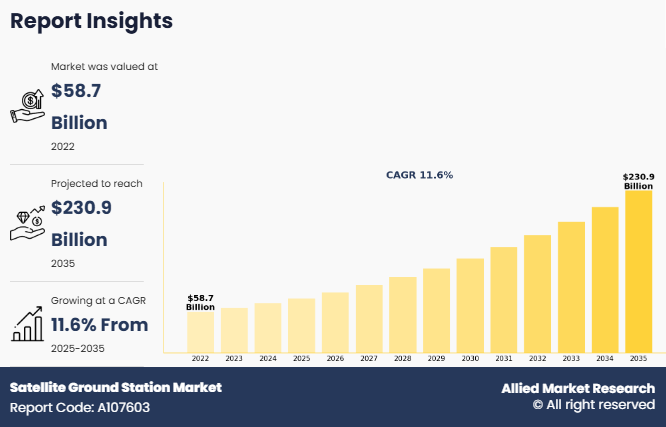
WILMINGTON, DE, UNITED STATES, May 22, 2026 /EINPresswire.com/ -- The satellite ground station market size was valued at $58.7 billion in 2022, and is estimated to reach $230.9 billion by 2035, growing at a CAGR of 11.6% from 2025 to 2035.A satellite ground station is a terrestrial facility equipped with antennas, radio-frequency transmitters and receivers, tracking systems, and control software that enables two-way communication with orbiting satellites such as those operated by ISRO. It functions as the primary interface between space-based assets and users on Earth by transmitting command and control signals to manage satellite operations (telemetry, tracking, and command), receiving payload data such as imagery or communication traffic, processing and routing this information to end users, and supporting mission planning, health monitoring, and orbit management, thereby ensuring reliable satellite operations across applications including telecommunications, navigation, Earth observation, weather monitoring, and scientific research.
Request the Sample PDF of this Report: https://www.alliedmarketresearch.com/request-sample/A107603
The satellite ground station market trends include strong growth driven by the rapid deployment of LEO and multi-orbit satellite constellations, rising demand for high-throughput data connectivity, and the increasing adoption of cloud-based, software-defined architectures and Ground Station-as-a-Service (GSaaS) models that enable scalable, automated, and real-time data processing capabilities. Rise in demand for satellite-based communication services drives satellite ground station market growth, as the rapid expansion of broadband connectivity, mobile backhaul, maritime and aviation communications, and remote-area coverage increases the need for reliable ground infrastructure to manage satellite links. The rollout of large LEO constellations by operators such as SpaceX through its Starlink network and Amazon’s Project Kuiper is significantly increasing the volume of satellite traffic, that requires geographically distributed and automated ground stations for telemetry, tracking, command (TT&C), data downlink, and network control. In parallel, rise in adoption of satellite communications by enterprises, government agencies, and defense organizations for secure connectivity, disaster response, and mission-critical operations is boosting investments in advanced ground station networks with higher throughput, low latency, and cloud-integrated architectures and drive the satellite ground station market size.
High capital investment and infrastructure costs significantly hamper the satellite ground station market growth, as establishing and operating ground stations requires substantial upfront spending on land acquisition, antenna systems, RF equipment, control software, secure data links, and ongoing maintenance. The need for geographically distributed stations to ensure continuous satellite visibility further increases costs related to site selection, regulatory approvals, power supply, and network integration. Smaller operators and emerging space startups often struggle to justify these investments, especially when competing with large-scale networks operated by players such as SpaceX and Amazon, which benefit from economies of scale and in-house infrastructure. In addition, high operational expenses for skilled personnel, spectrum licensing, cybersecurity, and system upgrades create financial barriers to entry, slowing new deployments and limiting market expansion, particularly in developing regions.
The growing deployment of low earth orbit (LEO) satellite constellations is creating satellite ground station market opportunities, as LEO networks require a much denser and more geographically distributed ground infrastructure compared to traditional GEO and MEO systems. The high orbital velocity and shorter visibility windows of LEO satellites increase the frequency of handovers and data downlink sessions, driving demand for a larger number of automated, multi-mission ground stations capable of seamless telemetry, tracking, and command (TT&C) as well as high-throughput data reception. This is accelerating investments in scalable ground station networks, virtualized control systems, and cloud-integrated architectures to efficiently manage the surge in satellite traffic.
LIMITED-TIME OFFER - Buy Now & Get Exclusive Discount on this Report @ https://www.alliedmarketresearch.com/checkout-final/065c4b26b2f08d510ee7c9f8505676b1
In addition, large-scale LEO programs led by operators such as SpaceX (Starlink) and Amazon (Project Kuiper) are encouraging partnerships with commercial ground station service providers to expand global coverage quickly without building all infrastructure in-house. This trend is opening new revenue streams for ground station-as-a-service models, shared infrastructure platforms, and edge data processing solutions. Moreover, the proliferation of small satellites and CubeSats within LEO constellations is fostering demand for cost-effective, modular, and software-defined ground stations, creating opportunities for technology providers to innovate in antenna design, automation, AI-driven scheduling, and network optimization.
The satellite ground station market segmentation include segmnets such as platform, function, orbit, end user, and region. On the basis of platform, it is divided into fixed, portable, and mobile. On the basis of function, it is classified into communication, earth observation, space research, navigation, and others. On the basis of orbit, it is categorized into LEO, MEO, and GEO. On the basis of end user, it is fragmented into commercial, government, and defense.
On the basis of platform, it is segmented into fixed, portable, mobile. The fixed segment dominated the market share in 2024. This is attributed to its critical role in supporting high-capacity, mission-critical satellite operations across communication, defense, earth observation, and space research applications. Fixed ground stations are typically equipped with large, high-gain antennas and advanced RF systems, enabling reliable and continuous connectivity with satellites in LEO, MEO, and GEO orbits. These installations are designed for long-term operations, offering superior performance, higher bandwidth capabilities, and enhanced signal stability compared to mobile or transportable ground stations.
However, the mobile segment is anticipated to grow at the fastest CAGR in the satellite ground station market driven by rise in demand for connectivity on the move across defense, maritime, aviation, and land mobility applications. Increase in deployment of LEO and multi-orbit constellations is enabling low-latency, high-throughput communications that support in-flight connectivity, connected naval fleets, unmanned systems, disaster response vehicles, and tactical military platforms.
Inquiry Before Buying @ https://www.alliedmarketresearch.com/purchase-enquiry/A107603
On the basis of function, it is classified into communication, earth observation, space research, navigation, and others. The communication segment dominated the market in 2024, primarily driven by the surge in global data consumption, expansion of broadband connectivity, and the rapid deployment of high-throughput satellites and LEO constellations. Increasing satellite ground station market demand such as DTH broadcasting, enterprise VSAT networks, in-flight and maritime connectivity, and rural broadband significantly boost the need for advanced ground station infrastructure. The rise in investments by satellite operators and service providers, including companies such as SpaceX and OneWeb, further fosters the growth of the communication segment by expanding global gateway networks and enhancing real-time data transmission capabilities.
However, the navigation segment is anticipated to grow at the fastest CAGR during satellite ground station market analysis. This growth is primarily driven by the expanding reliance on global navigation satellite systems (GNSS) for precision timing, autonomous mobility, aviation management, maritime navigation, defense operations, and critical infrastructure synchronization.
On the basis of orbit, it is classified into LEO, MEO, and GEO. The LEO segment dominated the market in 2024. driven by the rapid deployment of large-scale low Earth orbit constellations aimed at delivering high-speed, low-latency connectivity worldwide. The surge in demand for broadband internet, real-time data services, IoT connectivity, and defense communications significantly increased the need for advanced ground station networks capable of tracking and communicating with a high volume of fast-moving LEO satellites.
However, the GEO segment is anticipated to grow at the fastest CAGR in the satellite ground station market. This is attributed to sustained demand for high-capacity broadcasting, broadband backhaul, enterprise VSAT networks, and secure government communications. Geostationary satellites remain critical for wide-area coverage and uninterrupted service, particularly in remote and underserved regions, making them indispensable for national connectivity strategies and defense communication architectures.
On the basis of end user, it is classified into commercial, government, and defense. The commercial segment dominated the market in 2024 driven by the rapid expansion of private satellite operators, telecom providers, broadcasting companies, and space-tech startups investing heavily in satellite communication and data services. The increase in deployment of LEO constellations by companies such as SpaceX and OneWeb significantly boosts the demand for commercial ground station infrastructure to support broadband connectivity, enterprise networks, IoT applications, and media broadcasting.
Connect to Analyst: https://www.alliedmarketresearch.com/connect-to-analyst/A107603
However, the defense segment is anticipated to grow at the fastest CAGR in the satellite ground station market. This is due to rise in geopolitical tensions, modernization of military communication networks, and increasing investments in secure and resilient space-based infrastructure. Armed forces globally are prioritizing protected SATCOM, anti-jam capabilities, and multi-orbit interoperability to ensure uninterrupted command, control, communications, computers, intelligence, surveillance, and reconnaissance (C4ISR) operations.
Region wise, North America was the largest shareholder in the satellite ground station market in 2024, supported by strong investments in space infrastructure, the presence of leading satellite operators, and advanced technological capabilities. The region benefits from a well-established ecosystem led by organizations such as NASA and private space companies such as SpaceX, which continuously expand satellite constellations and require extensive ground station networks for mission control, data processing, and communication.
However, the Asia-Pacific region is anticipated to grow at the fastest CAGR in the satellite ground station market. This growth is driven by increase in government investments in space programs across countries such as India, China, and Japan, along with the rise in participation of private space companies. Expanding satellite launches for communication, earth observation, and navigation services are creating strong demand for new ground infrastructure. Additionally, the rapid growth of broadband connectivity, defense modernization programs, and increasing adoption of satellite-based services in remote and rural areas are further accelerating market expansion across the region.
Key players in the satellite ground station industry include Kratos Defense & Security Solutions, Inc, Comtech Telecommunications Corp, Viasat, Inc, SES S.A. EchoStar Corporation, GILAT SATELLITE NETWORKS, General Dynamics Corporation, Kongsberg Gruppen AS, ST Engineering, Communications & Power Industries LLC.
Key Findings of the Study
On the basis of platform, the fixed segment dominated the satellite ground station market share in 2024. However, mobile segment is anticipated to grow at the fastest CAGR during the forecast period.
On the basis of function, the communication segment dominated the satellite ground station industry in 2024. However, navigation segment is anticipated to grow at the fastest CAGR during the forecast period.
On the basis of orbit, the LEO segment dominated the satellite ground station industryin 2024. However GEO segment is anticipated to grow at the fastest CAGR during the forecast period.
On the basis of end user, the commercial segment dominated the market in 2024. However, defense segment anticipated to grow at the fastest CAGR during the forecast period.
The North America region accounted for the largest satellite ground station market share in 2024. However, Asia-Pacificis anticipated to grow at the fastest CAGR during the forecast period.
Similar Reports We Have on Aerospace and Defense Industry:
Satellite Services Market: https://www.alliedmarketresearch.com/satellite-services-market
Satellite Manufacturing Market: https://www.alliedmarketresearch.com/satellite-manufacturing-market-A13678
LEO and GEO Satellite Market: https://www.alliedmarketresearch.com/leo-and-geo-satellite-market-A09227
Satellite Connectivity Market: https://www.alliedmarketresearch.com/satellite-connectivity-market-A17100
Satellite Data Services Market: https://www.alliedmarketresearch.com/satellite-data-services-market-A06428
Commercial Satellite Imaging Market: https://www.alliedmarketresearch.com/commercial-satellite-imaging-market
Nanosatellite and Microsatellite Market: https://www.alliedmarketresearch.com/nanosatellite-and-microsatellite-market-A07491
Small Satellite Market: https://www.alliedmarketresearch.com/small-satellite-market
On-Orbit Satellite Servicing Market: https://www.alliedmarketresearch.com/on-orbit-satellite-servicing-market-A323206
David Correa
Allied Market Research
+ + + + + + + + + + + + +1 800-792-5285
email us here
Visit us on social media:
LinkedIn
Facebook
YouTube
X
What Sets Us Apart ? - Allied Market Research
Legal Disclaimer:
EIN Presswire provides this news content "as is" without warranty of any kind. We do not accept any responsibility or liability for the accuracy, content, images, videos, licenses, completeness, legality, or reliability of the information contained in this article. If you have any complaints or copyright issues related to this article, kindly contact the author above.
